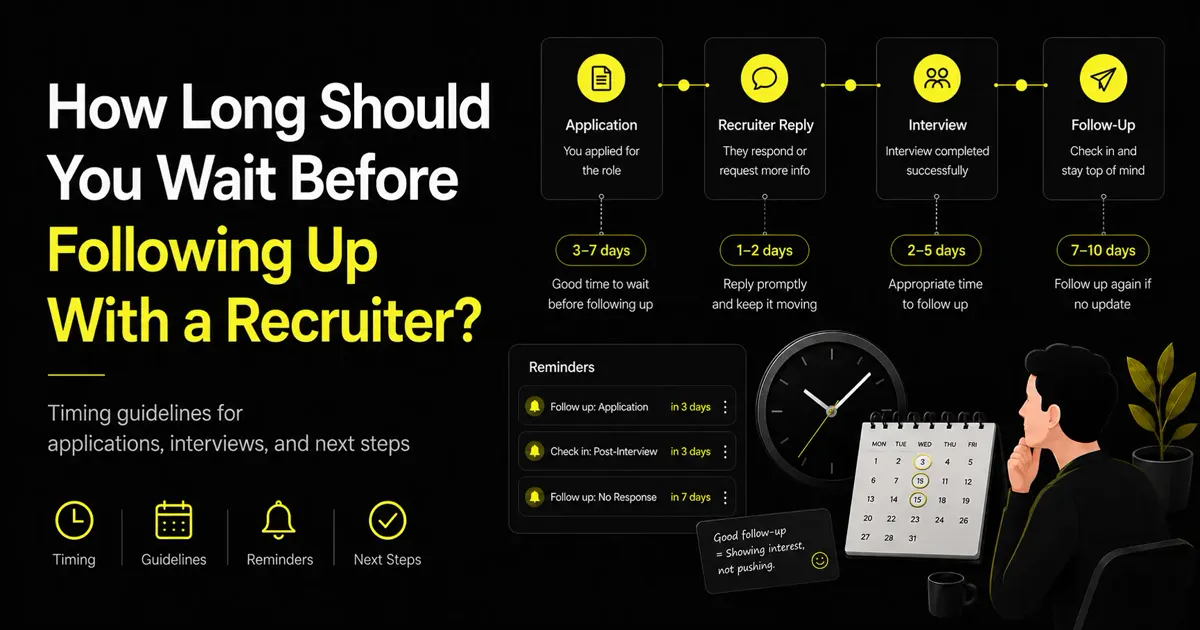
Quick answer: wait until any deadline the recruiter gave you has passed. If they did not give one, use stage-based windows—about 5–7 business days after applying, 2–3 after a recruiter message, and 3–5 after most interviews—then send one clear follow-up, not a stream of check-ins.
These are practical guidelines, not strict rules. Hiring timelines vary by company size, urgency, and internal chaos. The goal is to stay visible without becoming noise.
The one rule that overrides the table
When a recruiter gives a specific date—“we will update you by Friday” or “decisions go out next week”—wait until that date has passed before following up. Following up early usually does not speed anything up; it just signals impatience.
If they said “next week,” give them the full week plus one business day. If they said “end of month,” wait until the first business day after.
Reasonable follow-up timing by situation
| Situation | Reasonable follow-up timing |
|---|---|
| After submitting an application | About 5–7 business days |
| After a recruiter message | Around 2–3 business days |
| After a phone screen | Follow the timeline they gave; otherwise 3–5 business days |
| After an interview | Thank-you within 24 hours, then follow up after the stated deadline |
| After a final interview | Usually 3–5 business days after the expected decision date |
| After sending a follow-up | Wait another 5–7 business days before one final message |
Timing after you apply
Cold applications are the noisiest part of hiring. Recruiters may still be collecting candidates, waiting on a hiring manager, or sifting hundreds of resumes.
- Wait 5–7 business days before the first follow-up if you have a contact.
- If you only applied through a portal with no name, a follow-up is often impossible—focus energy on roles where you can actually reach someone.
- One short note is enough. You are confirming interest, not demanding a decision.
Timing after recruiter outreach
If a recruiter messaged you and you replied, the ball is often with them—but they may be coordinating calendars or waiting on the hiring team.
- If they promised a next step by a date, wait for that date.
- If they went quiet with no date, 2–3 business days is a fair first check-in.
- Keep the message light: confirm availability and interest, ask for the latest timeline.
Timing after each interview stage
After a phone or recruiter screen
Use whatever timeline they shared. If they said “I’ll loop back this week,” wait until the week is over. Without a timeline, 3–5 business days is reasonable.
After a full interview
- Send a short thank-you within 24 hours (same day is fine).
- Do not treat the thank-you as a status chase.
- Follow up for an update only after their stated decision date—or after 3–5 business days if they never gave one.
After a final interview
Final rounds often involve multiple decision-makers. Expect more delay.
- If they said “we’ll decide by Thursday,” follow up the next business day after Thursday if you hear nothing.
- Without a date, wait 3–5 business days, then one polite check-in.
- After a final follow-up with no reply, treat it as possible ghosting and keep your search moving.
How many follow-ups are appropriate?
For most processes:
- Thank-you after interviews (not a status demand).
- First status follow-up after a reasonable wait.
- One final follow-up several business days later.
That is usually the full set. A third or fourth “just checking in” rarely helps and can hurt your reputation with the same recruiting team.
Signs it is time to move on
You can stop waiting when:
- You have sent a first and final follow-up with no response
- The role posting is closed or removed
- The timeline they gave has slipped twice with no new date
- You would not accept the role if it came back after more silence
Mark the opportunity inactive, note the last contact date, and put your energy into live conversations. Silence is data—not a verdict on your worth.
A simple sequence you can reuse
- Note the last touchpoint and any promised date.
- Wait for that date—or the stage default from the table above.
- Send a short, specific follow-up (see email examples that don’t sound robotic).
- Wait 5–7 more business days.
- Send one final message.
- Continue applying elsewhere the whole time.
- After your deadline, mark the role inactive and stop refreshing your inbox for it.
Let software hold the wait, not your brain
Remembering every “follow up Friday” across ten applications is how job search stress multiplies. A tracker with next actions and dates—or a workspace like Caspr that keeps applications and follow-ups in one place—means you do not have to run a mental calendar for every silent thread.
Need a reminder that actually matches the stage you are in? Track the application, set the next follow-up, and free your attention for interviews that are still moving.
Bottom line
Follow the date they gave you. If they gave none, use stage-based windows, send at most two status follow-ups, and keep applying while you wait. Professional patience is a strategy—not the same thing as waiting forever.
Next step
Ready to search, match, and apply from one place?