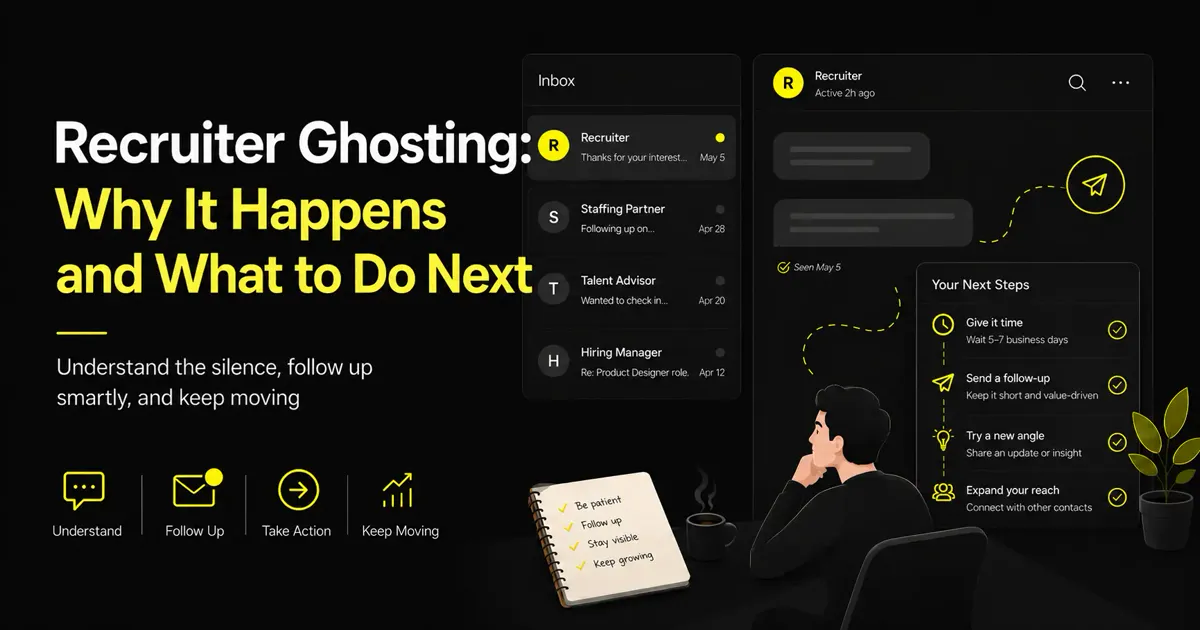
Recruiter ghosting is frustrating for a reason: you invested time, prepared, maybe interviewed—and then the thread just dies. That silence can feel personal. Often it is not.
Recruiter ghosting means a recruiter or hiring contact stops responding after some level of engagement—after an application conversation, a screen, or even late-stage interviews—without a clear close. It is unprofessional when it happens, and it is also common enough that you need a system for it.
This piece explains why it happens, how long to wait, what to send, and when to stop waiting—so ghosting does not run your whole search.
What recruiter ghosting means
Ghosting is not the same as a slow process. Slow means delayed but still responsive. Ghosting means you no longer get replies after a reasonable wait and follow-up.
It can start at different points:
- After you applied and got an initial reply
- After a recruiter screen
- After one or more interviews
- After they asked for references or paperwork
Later-stage silence hurts more—and still requires the same response: follow up cleanly, then reallocate your energy.
Why recruiters sometimes stop responding
Most of the time, ghosting is not a personal verdict. Common reasons include:
- The role was paused or cancelled
- Another candidate was selected and close-out messages slipped
- The hiring process is delayed (budget, headcount, reorg)
- The recruiter is juggling many open roles
- Internal priorities changed overnight
- Communication processes are simply poor
- The recruiter failed to follow up—human error, not strategy
None of these excuses the experience. They do explain why a perfect interview can still end in quiet. Avoid assuming malice; also avoid inventing reasons to wait forever.
How long to wait before assuming you were ghosted
Use the timeline they gave you first. If they said “by Friday,” Friday must pass before you count silence.
Rough defaults when no date was given:
| Stage | Wait before first follow-up | Assume likely ghosted after |
|---|---|---|
| After apply / light contact | 5–7 business days | Final follow-up + 5–7 more days of silence |
| After recruiter message | 2–3 business days | Same: first + final, then move on |
| After interview | Their date, or 3–5 business days | Final follow-up, then release it |
| After final interview | 3–5 business days past expected decision | Final follow-up, then mark inactive |
For a full stage-by-stage breakdown, see how long to wait before following up.
What message to send
Keep it brief and easy to answer.
Hi [Name], I wanted to follow up regarding the [Role] position. I’m still interested and would appreciate any update you can share about the hiring timeline. Thanks!
If you already interviewed, add one concrete detail:
Hi [Name], thanks again for the conversation about [topic]. I’m still very interested in the [Role] role and wanted to check whether there’s an updated timeline for next steps. Thanks!
More variants live in follow-up email examples that don’t sound robotic.
Should you follow up a second time?
Yes—once.
- First follow-up after a reasonable wait
- One final follow-up several business days later
- Stop status-chasing that opportunity
A second follow-up shows continued interest. A fifth follows desperation more than professionalism.
When to stop waiting
Stop waiting when you have:
- Hit their deadline (or a fair default)
- Sent a first and final follow-up
- Received no substantive reply
Then:
- Mark the opportunity inactive in your tracker
- Note the last contact date
- Leave the door open emotionally (sometimes people reappear)
- Do not pause your search for a silent process
If they return weeks later with an apology and a real process, you can re-engage on your terms. You do not owe infinite availability to radio silence.
How to keep momentum after ghosting
Ghosting drains motivation because it creates unfinished loops. Close the loop yourself:
- Send the follow-ups you planned
- Set a hard “inactive” date
- Move the role out of your active list
- Apply to the next targeted set of roles
- Protect interview prep time for conversations that are still alive
Tracking applications in one pipeline makes this mechanical instead of emotional: statuses change, next actions clear, silent roles stop living rent-free in your head.
A practical sequence
- Record the last touchpoint and any promised date
- Wait for that date (or the stage default)
- Send the first follow-up
- Wait another 5–7 business days
- Send one final follow-up
- Keep applying elsewhere the entire time
- After your deadline, mark the role inactive
That sequence is professional, finite, and repeatable.
Let tools carry the silent threads
The worst part of ghosting is not only the silence—it is replaying every open loop every morning. Caspr helps you keep applications and follow-ups in one place so you know who is due a nudge, who is inactive, and where your energy should go next—without mentally tracking every quiet recruiter.
You should not have to carry every silent process in your head. Track it, follow up once or twice, then move on with a full pipeline.
Bottom line
Ghosting is common, often structural, and still disrespectful of your time. Wait fairly, follow up twice at most, keep applying, and close inactive roles on purpose. Your search should run on systems—not on hope that one quiet inbox will suddenly open.
Next step
Ready to search, match, and apply from one place?