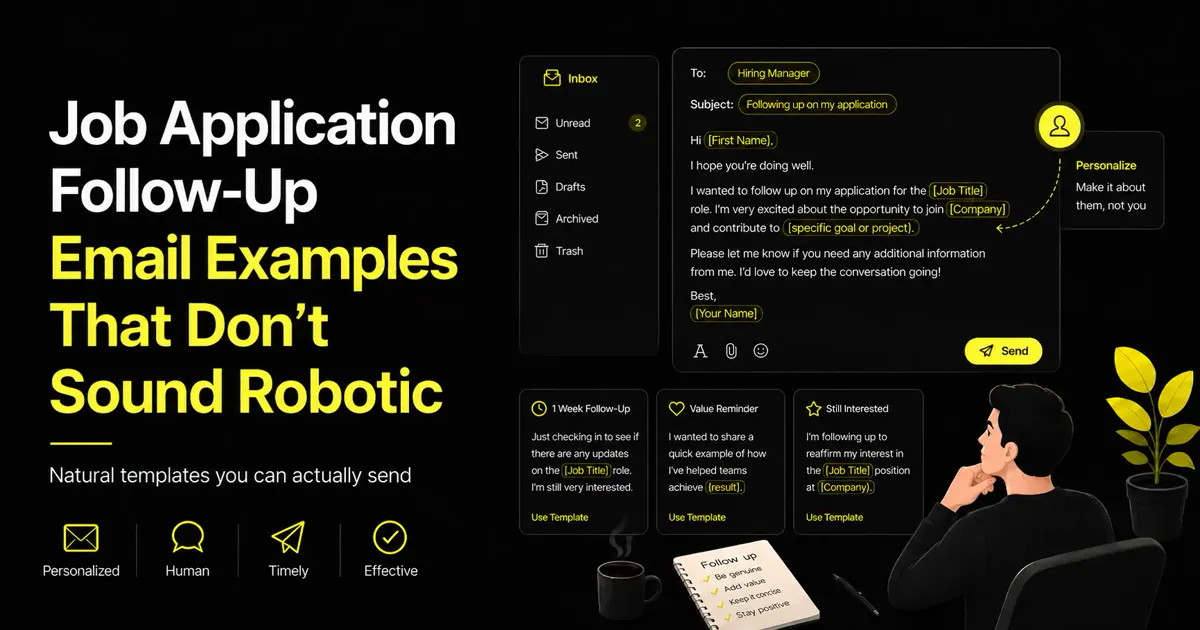
Most follow-up templates fail because they sound like they were written by a template. Phrases like “I hope this email finds you well” and “please don’t hesitate to reach out” waste space and signal autopilot.
Below are short, usable examples for real hiring stages—plus rules so you can adapt them without sounding robotic. Pair these with sensible follow-up timing so you are not sending great copy at the wrong moment.
How to personalize any template
Before you hit send, check:
- Name the role and company exactly as they use it
- Add one real detail—a conversation point, project, or skill they care about
- Keep it short—a few sentences, one clear ask
- Make the request obvious—timeline update, next steps, or confirmation they received your application
- Skip the apology tour—you do not need to say sorry for following up once
- Do not stack messages—space follow-ups several business days apart
If you cannot add a single specific detail, the message will still work—but specificity is what makes it feel human.
After submitting an application
Use when you have a recruiter or hiring-manager contact and enough time has passed.
Hi [Name],
I recently applied for the [Role] position and wanted to follow up. My experience with [relevant skill or project] seems closely aligned with what the team is looking for, and I’d be glad to discuss it further.
Thanks for your time.
[Your name]
Why it works: states the role, offers a reason to care, asks without pressure.
After a recruiter screen
Hi [Name],
Thanks again for speaking with me about the [Role] role. I enjoyed learning more about [team focus or challenge they mentioned], and I’m still very interested.
Do you have an updated sense of next steps or timeline?
Best,
[Your name]
Why it works: references a real conversation detail and asks one clean question.
After an interview
Hi [Name],
Thanks again for speaking with me about the [Role] position. I enjoyed learning more about [specific topic discussed]. I’m still very interested in the opportunity and wanted to ask whether there are any updates on the next steps.
Appreciate your time,
[Your name]
Send a thank-you within 24 hours of the interview. Use a status follow-up only after their timeline (or a reasonable wait) has passed—see the timing guide.
After the decision deadline passed
Hi [Name],
You mentioned you’d have an update by [date], so I wanted to check in on the [Role] process. I’m still interested and happy to provide anything else that would be helpful.
Thanks,
[Your name]
Why it works: anchors on their date, stays warm, offers help instead of demand.
Second follow-up after no response
Hi [Name],
Just checking in once more regarding the [Role] position. I understand timelines can change, but I’d appreciate any update you’re able to share.
Thanks again,
[Your name]
This should usually be your final status chase for that stage.
Final polite follow-up
Hi [Name],
I’ll keep this brief—still interested in the [Role] role if it’s open, and completely understand if priorities have shifted. If there’s any update you can share, I’d appreciate it. Either way, thanks for the time you’ve already given.
[Your name]
After this, move on without guilt. One more silence is an answer.
Informal LinkedIn follow-up
Keep LinkedIn even shorter than email.
Hi [Name] — following up on my application for [Role]. Happy to chat if helpful. Thanks!
Or after a conversation:
Hi [Name] — enjoyed our chat about [topic]. Still very interested in [Role]; any update on next steps?
Avoid multi-paragraph LinkedIn essays. If you need more room, email is better.
Subject lines that stay simple
- Following up: [Role] application
- Quick check-in on [Role]
- Next steps for [Role]?
- Thanks again — [Role] interview
Skip clickbait and false urgency. Recruiters open clear subjects faster than clever ones.
Common mistakes to avoid
- Writing a second cover letter in the follow-up
- Listing every skill again
- Following up daily
- CC’ing half the company
- Passive-aggressive lines (“as previously mentioned…”)
- Asking “did you get my email?” three times with no new value
Your job is to make responding easy: who you are, which role, what you need.
Keep templates where the applications live
Copy-paste from a notes app works until you have twelve open processes and no idea who is due for a nudge. Caspr is built so your applications, statuses, and follow-ups live together—so the right message goes to the right person at the right time, without hunting through old threads.
Stop rewriting the same follow-up from scratch. Track who needs a nudge, reuse language that sounds like you, and keep your search moving.
Related reading
- How long to wait before following up with a recruiter
- Recruiter ghosting: why it happens and what to do next
- How to track job applications without losing your mind
Bottom line
Good follow-ups are short, specific, and spaced out. Name the role, add one human detail, ask for a timeline, and stop after a final polite message. Clarity beats polish every time.
Next step
Ready to search, match, and apply from one place?