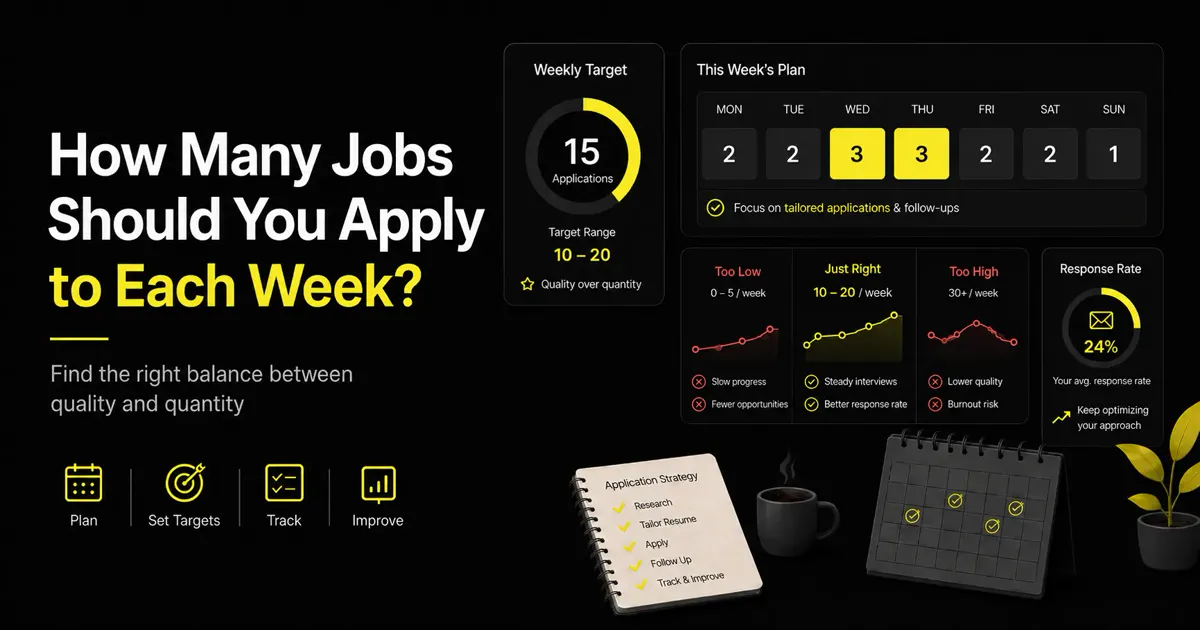
People want a single number: “Apply to 20 jobs a week and you’ll be fine.” Real searches do not work that way. The useful answer depends on application quality, experience level, industry, and how many hours you can honestly spend.
What follows are planning ranges, not guaranteed formulas. Use them to set a pace, then adjust with evidence from your own response rates.
Why there is no perfect application number
Two people can both send 15 applications a week and get totally different results:
- One is targeting a narrow, realistic band of roles with tailored materials
- The other is spraying generic resumes at every posting with the right keyword
Hiring markets also differ. A specialized senior role may have few openings worth your time. An entry-level search in a competitive field may need more volume to surface the same number of conversations.
So the question is not only “how many?”—it is “how many targeted applications can I sustain without quality collapsing?”
Quality versus quantity
Quality means:
- The role matches your skills and constraints
- Your resume (and any note) reflects this job’s needs
- You would accept an interview for it
- You can explain why you applied without inventing a story
Quantity means enough at-bats to create conversations. Zero applications guarantee zero interviews. Infinite generic applications often guarantee inbox silence and burnout.
A practical balance:
- Prefer fewer strong applications over many weak ones when you have a clear profile and scarce, senior, or specialized targets
- Accept higher volume when you are entry-level, changing fields, or in a market that filters heavily at the top of the funnel—still with a minimum bar for relevance
If you cannot explain why a role is a fit in one sentence, it probably should not count toward your weekly target.
Recommended ranges for different situations
| Situation | Suggested approach |
|---|---|
| Employed and casually searching | 5–10 targeted applications weekly |
| Actively searching | 10–25 targeted applications weekly |
| Urgently looking for work | Higher volume, but still prioritize relevant roles |
| Senior or specialized candidate | Fewer, highly customized applications |
| Entry-level candidate | More volume may be necessary |
How to read this table:
- Casually searching: protect your day job; depth over grind
- Actively searching: treat applications like a part-time project with blocks on the calendar
- Urgent: increase volume and fix funnel leaks early (resume, targeting) so you are not multiplying waste
- Senior / specialized: research and tailoring often matter more than raw count
- Entry-level: expect more noise in the market; volume helps, but spam still fails
These are weekly planning numbers for targeted applications—not “easy apply to everything that loads.”
How much time to spend on each application
Rough guides:
| Application type | Time ballpark |
|---|---|
| Strong fit, tailored resume + short note | 30–60 minutes |
| Good fit, light tailoring | 15–30 minutes |
| Referral or warm intro package | 45–90 minutes (worth it) |
| Mass easy-apply with no edits | Minutes—and usually low return |
If “actively searching” at 15 applications/week at 40 minutes each, that is about 10 hours before interview prep. Plan the time or the target is fiction.
Batch the boring parts (finding roles, logging applications) and protect deep focus for tailoring and interviews.
How to measure whether your strategy is working
Track a small set of metrics for 2–4 weeks:
| Metric | What it tells you |
|---|---|
| Applications sent | Are you hitting your plan? |
| Response rate | Are materials and targeting landing? |
| Interview rate | Are responses turning into real process? |
| Offer rate | Is the funnel converting at the end? |
| Applications per offer | How much top-of-funnel you need for one yes |
Simple definitions:
- Response rate = replies or screens ÷ applications
- Interview rate = interviews ÷ applications (or ÷ responses, if you prefer)
- Applications per offer = applications ÷ offers (over a longer window)
The “40 applications, zero interviews” problem
If you send 40 applications and receive no interviews, the solution is usually not sending another 100 the same way.
Check, in order:
- Targeting — wrong level, wrong industry, impossible requirements
- Resume and proof — unclear impact, missing must-have skills
- Role selection — applying where you are under- or over-qualified by a wide margin
- Channel — only cold portals; no referrals or direct contacts
- Volume quality — applications that were never truly targeted
Raise volume only after the top of the funnel is not obviously broken.
When to increase or reduce your application volume
Increase volume when:
- Response rate is decent but calendar is empty (need more at-bats)
- You have spare time and a stable targeting recipe
- You are early-career in a high-volume market
Reduce volume when:
- Interview prep is suffering
- Tailoring quality is dropping
- You already have multiple live processes
- You are burned out and making sloppy applications
Change strategy (not just volume) when:
- High volume + near-zero responses
- Responses that never convert to interviews
- Interviews that always die at the same stage
Tracking applications is what makes these calls factual instead of vibes-based.
A simple weekly planning loop
- Pick a situation row from the table above
- Set a weekly target range (e.g. 12–18)
- Block time for search + apply + admin
- Log every application the day you send it
- Review metrics every two weeks
- Adjust volume or quality inputs—not only volume
Keep follow-ups on a separate cadence so “applying more” does not replace timely recruiter follow-ups.
See the real numbers, not a guess
Most people remember the painful silences and forget the actual counts. When applications, statuses, and outcomes live in one place, you can see whether you need more volume, better targeting, or more recovery time.
Caspr keeps your job search pipeline visible so weekly goals stay honest—and so “I applied to a lot” becomes a number you can inspect, not a feeling.
Bottom line
There is no magic weekly number—only a sustainable range for your situation, protected quality, and metrics that tell you when to adjust. Start with the table, measure for a few weeks, and fix the funnel before you celebrate grinding harder.
Next step
Ready to search, match, and apply from one place?